Sunday, March 8, 2026
Before Silicon Valley: The Women Who Created Modern Computing

Authors Note:
As a young woman of colour in the technology industry, I have always wondered how I fit into the industry, if I should even be in these rooms. The industry prides itself on being fast-paced, proliferating new ideas and constantly shifting, yet it stays rooted in decades-old biases.
In this piece I wanted to highlight the women whom I wasn't taught about, connect their absence in history books to present ideologies, and touch on the link between TFGBV (tech-facilitated gender-based violence), gender norms and misogyny.
Women were always there, but men controlled the narrative. It was storytelling that painted women as inferior, and we are still feeling the effects of it today.
It comforts power structures. Exclusion is justified, and history is simplified.
The women who built the internet
The erasure spans as far back as the mid-1800s, when Ada Lovelace, a British mathematician, created the first computer program- a century before the computer was invented. In her annotations of an article about Charles Babbage’s Analytical Engine, a proposed mechanical general-purpose computer, she wrote an algorithm to process Bernoulli numbers (a sequence of rational numbers) using the computer. This demonstrated the capability of a machine to perform complex tasks and follow set instructions. The writing she had simply labelled as ‘notes’, laid the foundation for modern software.
Grace Hopper, known as the “Mother of computing” had many defining points in her career that helped shape technology as we know it. As a research fellow at Harvard, she worked on the Mark I and Mark II, which were two of the first fully functional electromechanical computers. She then oversaw the creation of UNIVAC, America’s first ever commercially successful computer, as well as led the team that created the first computer compiler.
Hedy Lamarr was a revered Hollywood actress during the time of World War II. She co-created a device that would minimise radio signal jamming to fight against the Nazis. Though it never made it to the battlefield, the device contributed to the development of Bluetooth, Wi-Fi and GPS.
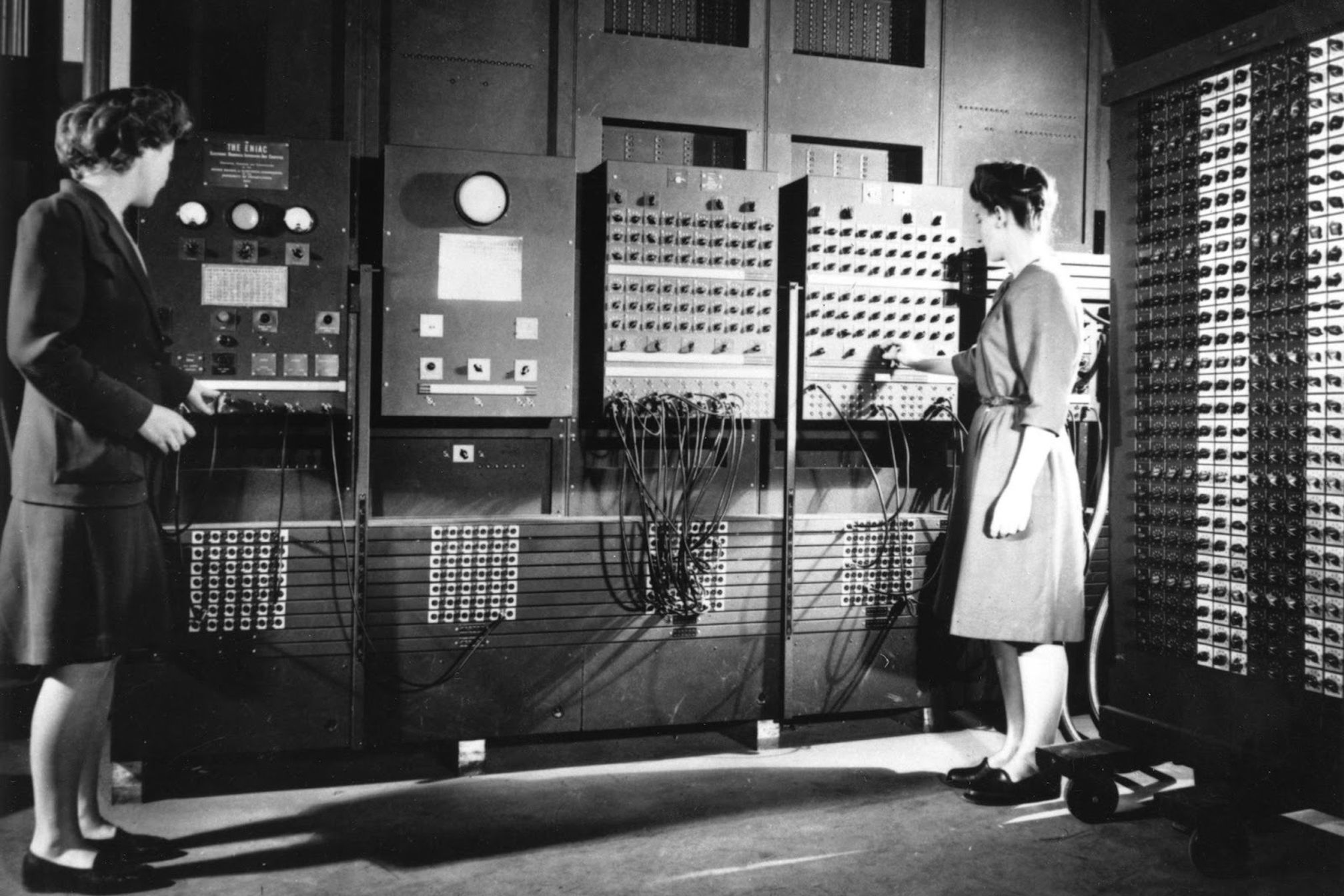
In 1942, the US Army recruited women as ‘human computers’. Jean Bartik, Kathleen Antonelli, Marlyn Meltzer, Betty Holberton, Frances Spence and Ruth Teitelbaum were a team of mathematicians and engineers who worked on the ENIAC, the first programmable, general-purpose all-electronic computer. The machine was designed to enhance the accuracy of artillery used in World War II. They manually did calculations using desktop calculators and would program by rewiring circuits in the machine. During the course of their work, they would develop multiple techniques that are fundamental to programming, like subroutines and nesting.
Media from just after World War II showed male engineers on reports of the ENIAC, but no mention of the six women. On the pictures that were found of them, their names were nowhere in sight, and their voices were never heard. The exclusion and erasure have always been intentional and explicit.
The contributions these women (and others) have made to technology and modern-day advancements are undeniable; yet, they have been undervalued and overlooked compared to their male counterparts.
The shift
In the mid 20th century, computer science as a field was seen as one for women. Men at the time saw programming as second to hardware; it wasn’t regarded with much respect due to its clerical nature.
Most appalling of all, it was believed that women working outside of the home were ‘a threat to national security’.
The joint effort of companies, media and government to push out the already minority was strenuous. As the pressure on women to stay at home increased, the workplace became more biased. Personality profiles and psychometric testing used during the interview process were geared towards favouring men due to the association of “masculine personality traits” with an inherent ability for programming.
Titles changed from “computer operators” to engineers, as soon as men took on the roles. It would take women exhibiting typically “male traits” to be considered smart.
Another wave of the depreciation of women's work occurred when femininity became a threat. Due to the traditional gender roles and nature of the Cold War, men being involved with anything remotely ‘feminine’ was seen as unmasculine and considered a failure as a man. The professionalisation and male-dominated culture of the field resulted in many women leaving or no longer trying to enter the workforce.
Genius became gendered, and it took women decades to receive recognition for their work.
The present
The “tech bro” persona and manosphere are direct products of the characterization we saw after the Cold War and the need to be seen as hyper-masculine.
Women in power are ridiculed and their competence is questioned. Yet, when unprofessional and borderline disgraceful behavior is perpetuated by grown men in power it’s excused for “boys being boys”.
Soft skills are only considered “soft” because they are commonly and historically attributed to women, yet without them, businesses are almost guaranteed to fail. This is a common theme seen in organisations who overlook communication and team work, and always leads to instability within a company.
And of course, all of this can be represented as the age-old metaphor of the “glass ceiling”.
Why erasure matters: losing influence over future systems
The exclusion of women during the development process of new products has led to fatal outcomes for many.
Deepfake systems that are only trained on women's bodies and used to create unconsensual pornography of women and CSAM (child sexual abuse material), racially biased AI-security systems, the spreading of misinformation, automated harassment, and more.
Forethought of these realities are almost nonexistent, people need to be put in dangerous situations for safeguarding to even be considered in certain cases. Violence will always be the outcome if women are not able to contribute and be in the rooms.
The lack of inclusion is deeply rooted in systemic practices, but we should know better as a society.
Companies need to be held accountable, governments need to intervene, and marginalized communities need to be represented and included; it is the only way forward to ensure the safety of people worldwide.
Share this
Blog
Latest read.
What happens when a South African video game challenges centuries of colonial storytelling? In this piece, archaeologist and paleoanthropologist Lauren Powell explores Relooted, an upcoming game by Nyamakop that turns the traditional "tomb raiding" narrative on its head. Through archaeology, museums, repatriation, and African history, she unpacks how gaming can become a powerful tool for reclaiming cultural heritage, restoring context to stolen artefacts, and reimagining who gets to tell Africa's stories.

The phenomenon of AI Cannibalism, technically known as Model Collapse, refers to a degenerative process that occurs when generative artificial intelligence models begin to be predominantly trained on data produced by other AIs. This feedback loop creates a "curse of recursion," where the nuances of original human information are lost, resulting in a convergence towards a simplified, homogeneous, and often hallucination-filled reality.

The industry prides itself on being fast-paced, proliferating new ideas and constantly shifting, yet it stays rooted in decades-old biases. In this piece I wanted to highlight the women whom I wasn't taught about, connect their absence in history books to present ideologies, and touch on the link between TFGBV (tech-facilitated gender-based violence), gender norms and misogyny.
Join us in building digital solutions as a foundation for lasting change.