Thursday, January 22, 2026
Alternative Pathways to African Leadership: Becoming an African Leadership Initiative Fellow

Authors Note:
Lisa Adams is the Founder of Citizen Code, an African–based technology collective building inclusive digital products for social impact. She has led the design of youth-focused platforms, AI-enabled chatbots, and web ecosystems that reach millions of young people across Africa and East Asia, with a strong focus on gender justice and digital equity.
She frequently speaks and writes on tech-facilitated gender-based violence, feminist approaches to technology leadership, and the intersection of heritage, culture, and innovation. Lisa represented Civil Society at the W20 pre-panel on the Future of STEM ahead of the G20, bringing her perspective as a technologist and advocate for accessible, community-rooted digital futures.
Today I’m sharing something deeply personal, and deeply affirming.
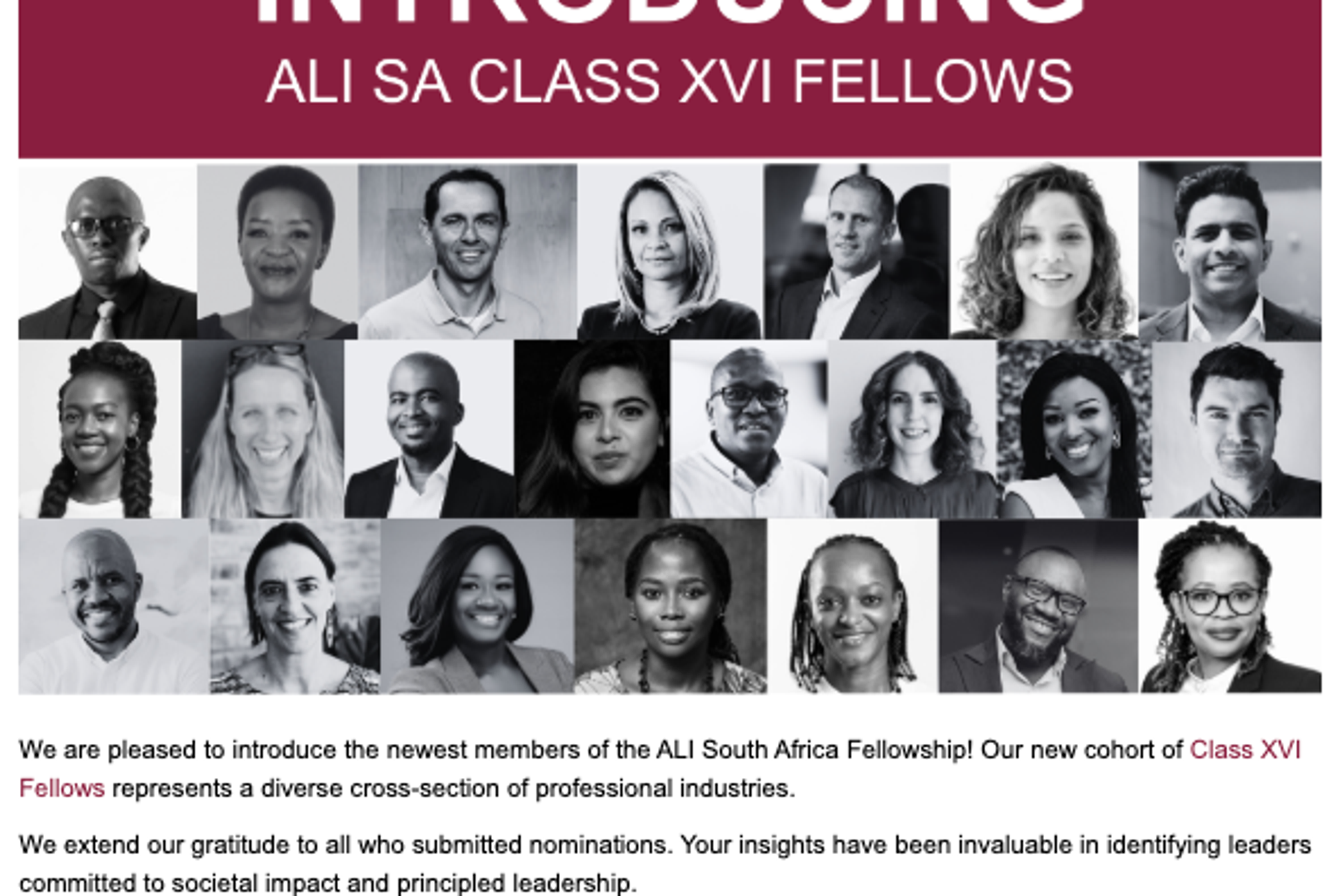
I’ve been selected as one of 22 Fellows in the African Leadership Institute (ALI).
This is not a programme you simply apply to and hope for the best. ALI is a highly selective, invitation-based fellowship that brings together a small cohort of leaders from across the continent who have demonstrated exceptional impact, depth of thinking, and long-term commitment to change. Its Fellows include heads of institutions, policymakers, scholars, movement builders, and leaders whose work has shaped African and global discourse across governance, justice, economics, culture, and innovation.
To be welcomed into this lineage, and to do so from a technical and practitioner background, is one of the greatest achievements of my career.
Not because of the title, but because of what it represents.
People often assume that those of us working in social impact arrived here through policy degrees, public change programmes, or traditional academic routes. And while many have, a significant number of us came in sideways, backwards, and sometimes simply out of necessity. We repurposed the skills we had to survive, to build, to fix, and eventually to change things.
My entry into this work was not strategic. It came from a place of survival.
It came from a raging fire in my soul to dedicate my life’s work to creating a better world for the girl child. The girl child I once was.
I grew up on the Cape Flats in Cape Town. In environments where violence was not an abstract concept, but a daily reality. Navigating danger became a sixth sense before the age of ten. You learned to read footsteps. You learned when to disappear. You learned how to stay quiet, alert, and ready.
In my household, what kept me sane was an old computer my mom somehow managed to get for me.
That computer was broken in all the ways old computers are. Slow. Bug-ridden. Temperamental. But it became my refuge when the shouting started, when things were breaking, when I knew someone was coming down the passageway with the intention to hurt me.
If that computer stopped working, my safe space disappeared. So I learned to keep it alive.
I learned how to troubleshoot without knowing the language for it yet. How to defragment a Windows 98 machine. How to fix errors through trial and failure. How to take hardware apart and replace parts with whatever I could borrow from friends or salvage from someone upgrading. I learned patience. Persistence. Pattern recognition. Logical thinking.
I did not know this was technical skill-building. I just knew I needed that machine to work.
An encyclopedia my uncle gave me became my favourite application. I was already a book nerd, but suddenly I could search, bookmark, test myself, and learn faster. Explore anything I was curious about, offline. I joke now that I am the kind of friend you would call on Who Wants to Be a Millionaire, very Slumdog Millionaire energy, but that curiosity was survival too.
There was no internet. There were libraries. User manuals. Occasional advice scribbled down by the IT guy at school. Running between books and practice, theory and trial, breaking things and fixing them again.
Looking back, that computer gave me more than distraction. It gave me agency.
It taught me that systems can be understood. That broken things can be fixed. That complexity is not something to fear. That learning does not only happen in classrooms.
Those early experiences shaped the technologist I would become. Not someone obsessed with novelty, but someone deeply invested in function, access, resilience, and care. Someone who understands that technology is never neutral, and that for many people it is not a luxury, but a lifeline.
This instinct has driven my entire career.
Over the past decade, I have led and built digital platforms, chatbots, and accessible technologies that have reached millions of young people across Africa, East Asia, and humanitarian contexts. From sexual and reproductive health tools for adolescent girls, to GBV response systems, to low-data platforms designed for old devices and fragile infrastructure.
These are not experimental prototypes. They are systems in daily use. Platforms that have handled millions of conversations. Tools that sit quietly in the background of real lives, supporting people navigating violence, health systems, poverty, and structural exclusion.
I have spent years designing for constraints. Low connectivity. No connectivity. Shared phones. Older devices. Fear of surveillance. Language diversity. Trauma. Shame. Risk.
That on-the-ground experience has taught me things no textbook could. It has shaped how I think about ethics, power, care, and responsibility in technology. It has made me deeply skeptical of one-size-fits-all solutions, and deeply committed to context-led design.
Being accepted into ALI affirms something I have always known, but rarely saw reflected back to me.
- That there are alternative pathways to leadership.
- That technical excellence does not only come from formal institutions.
- That lived experience is a form of expertise.
- That building under constraint is not a weakness, but a strength.
ALI is a space that values rigorous thinking, reflection, and contribution. To be recognised not despite my unconventional path, but because of it, feels profoundly full-circle.
From this year onward, I am intentionally committing to doing more than practice alone.
I want to more deliberately bridge my practical, on-the-ground experience into academic and institutional spaces. To contribute to how technology leadership is taught, studied, and understood on the continent. To bring lessons from real systems, real failures, and real impact into conversations that too often remain abstract.
ALI offers not just a fellowship, but a responsibility. An invitation to help shape knowledge, not only consume it. To challenge dominant narratives about who gets to be considered a leader, a thinker, or an expert.
For the girl I once was, sitting in front of a flickering screen, fixing what she could so she could survive another night, this moment matters more than I can fully put into words.
And for the work still ahead, this feels like a beginning, not a culmination.
Share this
Blog
Latest read.
What happens when a South African video game challenges centuries of colonial storytelling? In this piece, archaeologist and paleoanthropologist Lauren Powell explores Relooted, an upcoming game by Nyamakop that turns the traditional "tomb raiding" narrative on its head. Through archaeology, museums, repatriation, and African history, she unpacks how gaming can become a powerful tool for reclaiming cultural heritage, restoring context to stolen artefacts, and reimagining who gets to tell Africa's stories.

The phenomenon of AI Cannibalism, technically known as Model Collapse, refers to a degenerative process that occurs when generative artificial intelligence models begin to be predominantly trained on data produced by other AIs. This feedback loop creates a "curse of recursion," where the nuances of original human information are lost, resulting in a convergence towards a simplified, homogeneous, and often hallucination-filled reality.

The industry prides itself on being fast-paced, proliferating new ideas and constantly shifting, yet it stays rooted in decades-old biases. In this piece I wanted to highlight the women whom I wasn't taught about, connect their absence in history books to present ideologies, and touch on the link between TFGBV (tech-facilitated gender-based violence), gender norms and misogyny.

Join us in building digital solutions as a foundation for lasting change.